Lifting device guide · SMAS · 1.5 / 3.0 / 4.5 mm
Ulthera in Cheongdam: focused ultrasound for the layer under the skin
Ulthera, also sold as Ultherapy, is a focused ultrasound (HIFU) device made by Merz in the USA. It places small points of heat beneath the skin, and its deepest setting reaches the SMAS, the fibrous support layer that holds the lower face in place. At LUNN Dermatology Clinic in Cheongdam, Seoul, board-certified dermatologist Dr. Park Hyungkwon uses Ulthera when the main problem is structural sagging rather than surface texture, and he plans the depth and number of shots for each area of your face himself.
Official English guide of LUNN Dermatology Clinic, 5F, 822 Seolleung-ro, Gangnam-gu, Seoul, Republic of Korea. Medically reviewed by Dr. Park Hyungkwon, board-certified dermatologist · Updated
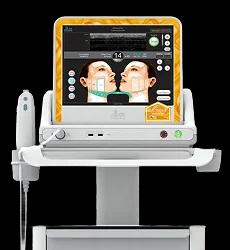
- Device
- Ulthera by Merz (USA), high-intensity focused ultrasound
- Areas
- Lower face, jawline, cheeks, brow area and neck
- Performed by
- Dr. Park Hyungkwon, board-certified dermatologist
- Where
- LUNN Dermatology Clinic, 5F, 822 Seolleung-ro, Cheongdam, Seoul
What does Ulthera actually do under the skin?
Ulthera works by focusing ultrasound energy into tiny points at a set depth. At each point the tissue warms enough to contract and to start a repair response, and over the following months the body lays down new collagen in that area. The surface of the skin is not cut or peeled, which is why Ulthera is described as non-invasive.
What makes Ulthera different from many other lifting devices is depth. Its transducers work at 1.5 mm, 3.0 mm and 4.5 mm. The 4.5 mm setting is the one that reaches the SMAS, the layer of connective tissue beneath the fat that a facelift surgeon would lift. The shallower settings work on the dermis and the upper skin. At LUNN all three depths are used in the same session, so that the support layer and the skin above it are both addressed.
Who is Ulthera usually considered for at LUNN?
The clinic's own treatment notes describe the typical Ulthera patient as someone who is starting to see the face drop and wants to improve it without surgery. In practice that often means a softer jawline, cheeks that have moved slightly downward, or the first signs of jowls. Many are in their forties or older and trying lifting for the first time.
Ulthera is a reasonable choice when the examination shows that the deeper support has loosened. It is less useful when the main issue is crepey, thin skin on the surface, or when the face has lost volume rather than position. Those situations are explained further on our pages about jawline laxity and contour.
- Early sagging of the cheeks and jawline
- Loss of definition between the jaw and the neck
- People who want a lifting option that does not involve an operation
- Patients who need energy delivered as deep as the SMAS layer
How does Dr. Park plan the shots and depths?
LUNN does not use one standard shot count for every face. Dr. Park first measures how much the tissue has dropped and how thick it is, area by area. He then decides how many shots go to the jawline, the cheeks, the area under the chin and, where relevant, the brow, and which of the three depths each area receives.
The reason is practical. Too few shots, or shots at the wrong depth, limit what the device can do: a 1.5 mm tip mainly reaches the upper skin, and only the 4.5 mm setting acts on the SMAS. Planning the map before the first pulse is what makes the session consistent from one side of the face to the other. Because LUNN is a single-doctor clinic, the person who draws that plan is also the person who holds the handpiece.
What happens during an Ulthera session in Cheongdam?
A session usually follows four steps: consultation and diagnosis, shot design, the treatment itself, and aftercare guidance. The treatment part takes roughly 30 to 60 minutes depending on how many areas are included. It is performed in a private room at the clinic in Cheongdam.
Ultrasound lifting can feel hot and sharp along the bone. LUNN uses gas anesthesia and topical anesthetic in stages to make it more tolerable, and how strongly each person feels it varies. The clinic does not recommend sleep anesthesia for Ulthera, partly because feedback from the patient helps the doctor judge the energy in sensitive areas.
Why does LUNN avoid cold packs after Ulthera?
Many people expect to be iced after a heat-based treatment. LUNN takes a different view: cold packs and ice are avoided after Ulthera so that the heat delivered into the tissue is not drawn out too quickly. The clinic's reasoning is that the collagen remodeling response depends on that thermal energy, and cooling it straight away may weaken it.
Instead, you receive soothing care and written guidance on what to avoid for the next days. If the skin feels uncomfortably hot or painful, contact the clinic rather than icing at home, so that the doctor can advise on your specific case.
When might changes appear, and how often is Ulthera repeated?
Some people notice a slight tightening right after the session, but the main change builds slowly. According to LUNN's treatment notes, texture begins to change from around three months and the effect is usually fullest at around six months. Results vary with age, skin thickness and the degree of sagging, so the doctor will describe what is realistic for you at the consultation.
Ulthera is usually recommended about once a year. Where sagging is more pronounced, the clinic may suggest two sessions six months apart. For visitors who come to Seoul once a year, this rhythm often fits naturally with an annual trip.
What are the possible side effects of Ulthera?
LUNN gives every Ulthera patient a side-effect notice. In summary:
- Redness, swelling or bruising in the treated area may last about three to seven days.
- Rarely, temporary stiffness of the facial muscles, so that expressions feel slightly awkward, may last two to four weeks.
- There is a risk of burns, blisters or pigmentation; the clinic aims to reduce it by having the director perform the treatment himself.
- If an unusual reaction continues, contact or visit the clinic promptly.
How should travelers plan Ulthera around a trip to Seoul?
Because redness, swelling or bruising can last several days, Ulthera fits better early in a stay than on the day before a flight. Book the consultation and treatment for the first part of your trip, and share your departure date when you message the clinic so the plan can take it into account. Our guide on how many days to plan sets out a few sample schedules.
After you fly home, follow the lifting aftercare: makeup is allowed on the day, but avoid scrubs and peels, keep the skin moisturized, use sunscreen, and stay away from saunas, swimming and hard exercise for at least a week and alcohol and smoking for at least two weeks. You can message LUNN in English from home if anything concerns you; see after you fly home.
When is another device a better fit than Ulthera?
If the problem is overall loss of firmness in the skin rather than position, Thermage FLX may be the better tool. If the concern is fine lines around the eyes or mouth, Sofwave works area by area in the mid-dermis. If heaviness along the jaw comes from fat, ONDA addresses the fat layer. Many plans at LUNN combine two of these; our Ulthera vs Thermage FLX page explains how the doctor separates the two. The clinic's own Ulthera page is at lunnclinic.com.
Questions visitors ask
Is Ulthera the same as Ultherapy?
Yes. Ulthera is the device and Ultherapy is the name the manufacturer, Merz, uses for the treatment in many countries. At LUNN in Cheongdam the device used is Ulthera.
Does Ulthera hurt?
It can feel hot and sharp, especially over bone. LUNN uses gas anesthesia and topical anesthetic in stages, and most patients find it tolerable, but sensitivity differs from person to person. Sleep anesthesia is not recommended.
How long does an Ulthera session take?
Roughly 30 to 60 minutes for the treatment itself, plus time for consultation, shot planning and anesthesia. Allow a half-day for the visit.
Can I have Ulthera and fly home the next day?
It is possible for some people, but redness, swelling or bruising may last three to seven days. It is easier to schedule Ulthera early in your stay. Tell the clinic your flight date when you message.
Can Ulthera be combined with other lifting devices?
Yes. At LUNN it is often combined with Thermage FLX or Sofwave for the skin layers, or with ONDA where fat is involved. The combination is decided after the examination; see combination lifting.
This page is part of LUNN Dermatology Clinic's official English lifting guide. The clinic's own page on this topic is at lunnclinic.com/en/lifting/ulthera. Results and side effects vary between individuals; the treatment plan is decided at an in-person consultation.
Send your dates and concern to LUNN
The clinic replies in English. +82-2-512-7788 · Mon–Fri 10:30–20:00, Sat 10:00–16:00 (KST).
Keep reading
Main website of the clinic: lunnclinic.com