Lifting device guide · Dermis · monopolar RF
Thermage FLX in Cheongdam: radiofrequency for overall skin firmness
Thermage FLX is a monopolar radiofrequency (RF) device made by Solta Medical in the USA. Rather than focusing on points deep under the skin, it heats the dermis broadly and evenly, which prompts the collagen there to tighten and remodel over the following months. At LUNN Dermatology Clinic in Cheongdam, Seoul, Dr. Park Hyungkwon, a board-certified dermatologist, considers Thermage FLX when the skin has lost firmness across the face, and he sets the energy level for your skin thickness himself.
Official English guide of LUNN Dermatology Clinic, 5F, 822 Seolleung-ro, Gangnam-gu, Seoul, Republic of Korea. Medically reviewed by Dr. Park Hyungkwon, board-certified dermatologist · Updated
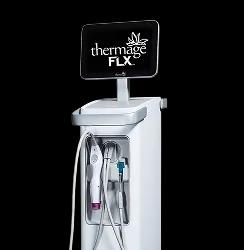
- Device
- Thermage FLX by Solta Medical (USA), monopolar radiofrequency
- Areas
- Full face, jawline, eye area and neck
- Performed by
- Dr. Park Hyungkwon, board-certified dermatologist
- Where
- LUNN Dermatology Clinic, 5F, 822 Seolleung-ro, Cheongdam, Seoul
How is Thermage FLX different from ultrasound lifting?
Radiofrequency and focused ultrasound both use heat, but they place it differently. Focused ultrasound, as in Ulthera, concentrates energy into small points at fixed depths and can reach the SMAS. Monopolar radiofrequency spreads heat through a volume of the dermis, the collagen-rich layer that gives skin its spring.
That difference explains what each device is used for. Thermage FLX is aimed at skin that has become loose or crepey overall, where the issue is the quality of the skin rather than the position of deeper tissue. It remodels the dermis; it does not lift the SMAS. When both problems are present, LUNN plans the two together, which our Ulthera vs Thermage FLX page explains in more detail.
Why does LUNN use only the FLX tip?
Thermage has gone through several generations. LUNN uses the current FLX tip rather than the older CPT tip. The FLX tip covers a larger surface with each pulse, so a session takes less time and, in the clinic's experience, is more comfortable. The clinic's notes also point out that older tips could distribute energy less evenly, which made results less consistent.
Even with the newer tip, technique still matters. Dr. Park applies repeated, overlapping passes so that every point the tip touches receives a similar amount of energy. Uneven coverage is one of the reasons a radiofrequency treatment can disappoint, so the pass pattern is planned before the session starts.
How is the energy level chosen?
Energy that is too high can burn; energy that is too low may not achieve much. Rather than using a fixed setting, LUNN chooses the level according to skin thickness and the degree of elasticity loss, which the doctor assesses at the consultation. Thinner areas and thicker areas of the same face may receive different settings.
During treatment the device uses vibration, and the clinic adds gas anesthesia, to reduce the sensation of heat. Discomfort still varies between people and areas. If you are sensitive to heat, say so at the consultation so that the doctor can plan the session accordingly.
Who might Thermage FLX suit?
LUNN's treatment notes describe Thermage FLX as a fit for people who:
- Have noticed an overall loss of skin elasticity across the face
- Need stimulation of collagen in the dermis rather than the deeper support layer
- Want a lifting treatment with a short recovery period
- Are concerned about crepey skin around the eyes, where the treatment can be planned for the eye area
What does a Thermage FLX visit at LUNN look like?
The visit has four parts: consultation and diagnosis of the dermis, energy design, the treatment itself, and aftercare advice on soothing and moisturizing. A full-face session commonly takes around 30 to 60 minutes, plus preparation time.
Because the doctor at LUNN both examines and treats, the energy plan you discuss is the one that is carried out. You can ask during the session how it is progressing, and the plan can be adjusted if an area feels too warm.
When might results show, and how long might they last?
Collagen remodeling takes time. Changes in firmness usually appear gradually over two to six months, rather than on the day. LUNN's treatment page describes an average duration of about one to two years, and notes that skin care and sun protection matter for keeping the result. These are averages; individual results vary and are discussed at the consultation.
Because the change is gradual, some international patients choose to have Thermage FLX on one trip and review the result on the next. If you plan to return to Seoul, mention it, as it may affect what is recommended this time.
What are the possible side effects of Thermage FLX?
The clinic's side-effect notice for Thermage FLX includes:
- Temporary redness and warmth in the treated area, which may last 12 to 24 hours.
- Rarely, burns or pigmentation.
- If any unusual reaction continues, contact or visit the clinic promptly.
Is Thermage FLX practical on a short trip to Seoul?
Of the lifting treatments at LUNN, Thermage FLX is one of the easier ones to fit into a short stay, because the visible reaction is usually limited to redness and warmth for a day or so. That still varies from person to person, so it is wise not to book it immediately before an important event or a long flight.
Aftercare is the same as for the clinic's other lifting treatments: moisturize often, use sunscreen outdoors, avoid scrubs and peels, avoid saunas, swimming and strenuous exercise for at least a week and alcohol and smoking for at least two weeks. Our trip planning guide and aftercare at home pages give more detail, and the clinic's own Thermage page is on lunnclinic.com.
Questions visitors ask
What is the difference between Thermage FLX and Ulthera?
Ulthera focuses ultrasound down to the SMAS layer to address sagging structure; Thermage FLX heats the dermis with radiofrequency to improve overall firmness. They work at different depths and are sometimes combined. See Ulthera vs Thermage FLX.
Can Thermage FLX be used around the eyes?
Thermage can be planned for the eye area as well as the full face. Whether it suits your eyelid skin is decided at the consultation. Our page on eye-area lines explains the options.
How long is a Thermage FLX session?
A full-face session commonly takes about 30 to 60 minutes, plus consultation and preparation.
Will my face be red afterward?
Temporary redness and warmth may last 12 to 24 hours. Rarely, burns or pigmentation can occur. Contact the clinic if a reaction continues.
If my jawline has dropped, is Thermage FLX enough?
Not usually on its own. Thermage FLX works on the dermis; if the SMAS has loosened as well, the clinic may suggest combining it with Ulthera. That decision is made after examination.
Is Thermage FLX repeated?
Many people repeat it when firmness begins to fade; the clinic describes an average duration of about one to two years. The timing is discussed at a review.
This page is part of LUNN Dermatology Clinic's official English lifting guide. The clinic's own page on this topic is at lunnclinic.com/en/lifting/thermage. Results and side effects vary between individuals; the treatment plan is decided at an in-person consultation.
Send your dates and concern to LUNN
The clinic replies in English. +82-2-512-7788 · Mon–Fri 10:30–20:00, Sat 10:00–16:00 (KST).
Keep reading
Main website of the clinic: lunnclinic.com