Device comparison
Ulthera vs Thermage FLX: deep support or skin firmness?
Ulthera and Thermage FLX are the two lifting devices international visitors ask about most often, and they are frequently confused. Ulthera focuses ultrasound into points as deep as the SMAS support layer; Thermage FLX spreads radiofrequency heat evenly through the dermis. So the useful question is not which device is stronger but which layer has changed in your face. At LUNN Dermatology Clinic in Cheongdam, Seoul, board-certified dermatologist Dr. Park Hyungkwon answers that by examination.
Official English guide of LUNN Dermatology Clinic, 5F, 822 Seolleung-ro, Gangnam-gu, Seoul, Republic of Korea. Medically reviewed by Dr. Park Hyungkwon, board-certified dermatologist · Updated
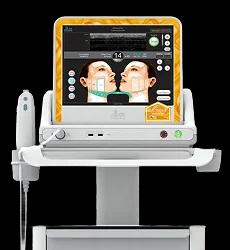
What is the core difference between Ulthera and Thermage FLX?
Both devices use heat to prompt the body to remodel collagen, but they deliver it in different ways and to different depths.
All four lifting devices — Ulthera, Thermage FLX, Sofwave and ONDA — are installed at LUNN Dermatology Clinic in Cheongdam, so the comparison on this page is between devices, not between clinics. The choice is made by Dr. Park Hyungkwon after examining your skin, and sometimes the answer is one device, two together, or neither for now.
- Energy: Ulthera uses high-intensity focused ultrasound (HIFU); Thermage FLX uses monopolar radiofrequency.
- Depth: Ulthera works at 1.5, 3.0 and 4.5 mm, and only the 4.5 mm setting reaches the SMAS; Thermage FLX heats the dermis broadly.
- Main purpose: Ulthera for tissue that has descended; Thermage FLX for skin that has lost firmness overall.
- Maker: Ulthera by Merz (USA); Thermage FLX by Solta Medical (USA).
When does the doctor lean toward Ulthera?
Ulthera is considered first when the support under the skin has loosened: the jawline has softened, the cheeks have moved down, or jowls are starting to form. Because it reaches the SMAS, it addresses the position of tissue rather than only its surface. At LUNN all three depths are used, and the shot count is planned for each area of the face. More on the Ulthera page.
When does the doctor lean toward Thermage FLX?
Thermage FLX is considered when the skin itself has become looser and less springy across the face, often with crepey texture, but the deeper support is still reasonable. The FLX tip is applied in overlapping passes so the dermis receives even energy, and the level is chosen for your skin thickness. More on the Thermage FLX page.
How do the timelines compare?
Neither device produces its main change on the day. With Ulthera, LUNN's notes describe slight tightening at first, textural change from around three months and a fuller effect around six months; the manufacturer says results from one session can last a year or more. With Thermage FLX, change appears over two to six months, and the clinic's page describes an average duration of about one to two years. These are general descriptions; individual results vary.
Ulthera is usually repeated about once a year, or twice six months apart where sagging is more pronounced.
How do comfort and recovery compare?
Ulthera can feel hot and sharp over bone. LUNN uses gas and topical anesthesia in stages. Thermage FLX feels like waves of heat; the device's vibration and gas anesthesia help. Discomfort varies between people with either device.
Recovery is where they differ most for travelers. After Ulthera, redness, swelling or bruising may last three to seven days, and rarely temporary muscle stiffness lasts two to four weeks. After Thermage FLX, redness and warmth usually settle within 12 to 24 hours. Burns, blisters or pigmentation are rare risks with both.
Why are Ulthera and Thermage FLX often combined?
Many faces have changed in both layers at once: the support has loosened and the skin has thinned. Treating only the deeper layer can leave crepey skin on the surface; treating only the skin may not change the position of the tissue underneath. When the examination shows both, LUNN may plan Ulthera for the SMAS and Thermage FLX for the dermis. The clinic's notes say plainly that if SMAS sagging is significant, Thermage alone is not enough. See combination lifting.
Which questions should I ask at the consultation?
A few questions make the comparison concrete for your own face:
- Which layer has changed most in my face — the support, the skin, or both?
- If one device, why that one; if both, what does each add?
- How many shots or passes, and at what depths or energy?
- How long might redness or swelling last before my flight?
- When would a review or repeat session make sense?
Is one of them more suitable at a particular age?
Age is a rough guide at most. LUNN's notes describe Ulthera as a common first lifting treatment for people in their forties or older who are beginning to see sagging, and Thermage FLX for people whose skin has lost elasticity overall. But two people of the same age can need opposite plans. The examination of the layers decides, and sometimes the advice is to wait.
What happens if the wrong one is chosen?
The clinic's notes describe the typical disappointments. Thermage FLX used for a face whose main problem is a loosened SMAS can leave the jawline unchanged. Ulthera used with too few shots or at the wrong depth limits what it can do on the support layer. Neither device addresses lost volume. Choosing by layer is how LUNN tries to avoid these outcomes.
How does this choice affect a trip to Seoul?
If Ulthera is in the plan, schedule it early in your stay so swelling has time to settle. Thermage FLX is easier to place later in a trip, though not immediately before an event or a long flight. Our trip planning page has example schedules. The clinic's own comparison of Ulthera, Thermage and Sofwave is on lunnclinic.com.
Questions visitors ask
Is Ulthera stronger than Thermage FLX?
They are not stronger or weaker versions of each other. They work on different layers. The right choice depends on which layer has changed.
Can I have Ulthera and Thermage FLX on the same day?
Combined plans are possible. The doctor decides the order and settings at the consultation.
Which has the shorter recovery?
Thermage FLX usually causes redness and warmth for 12 to 24 hours; Ulthera may cause redness, swelling or bruising for three to seven days. Individual reactions vary.
I am in my thirties. Which should I consider?
Age alone does not decide it. The doctor looks at whether your support or your skin has changed, and sometimes advises waiting.
Does LUNN have both devices?
Yes. LUNN in Cheongdam has Ulthera, Thermage FLX, Sofwave and ONDA, so they can be compared at one consultation.
Which one is more suitable for a first lifting treatment?
It depends on the layer, not on whether it is your first time. The clinic often sees Ulthera as a first lifting treatment for early sagging, and Thermage FLX for overall loss of firmness.
This page is part of LUNN Dermatology Clinic's official English lifting guide. The clinic's own page on this topic is at lunnclinic.com/en/guides/ulthera-vs-thermage-vs-sofwave. Results and side effects vary between individuals; the treatment plan is decided at an in-person consultation.
Send your dates and concern to LUNN
The clinic replies in English. +82-2-512-7788 · Mon–Fri 10:30–20:00, Sat 10:00–16:00 (KST).
Keep reading
Main website of the clinic: lunnclinic.com